Senior Aerospace Design Capstone
Controls Engineer — Autonomous RC Aircraft with Multi-Waypoint Autopilot
View Critical Design Review (CDR)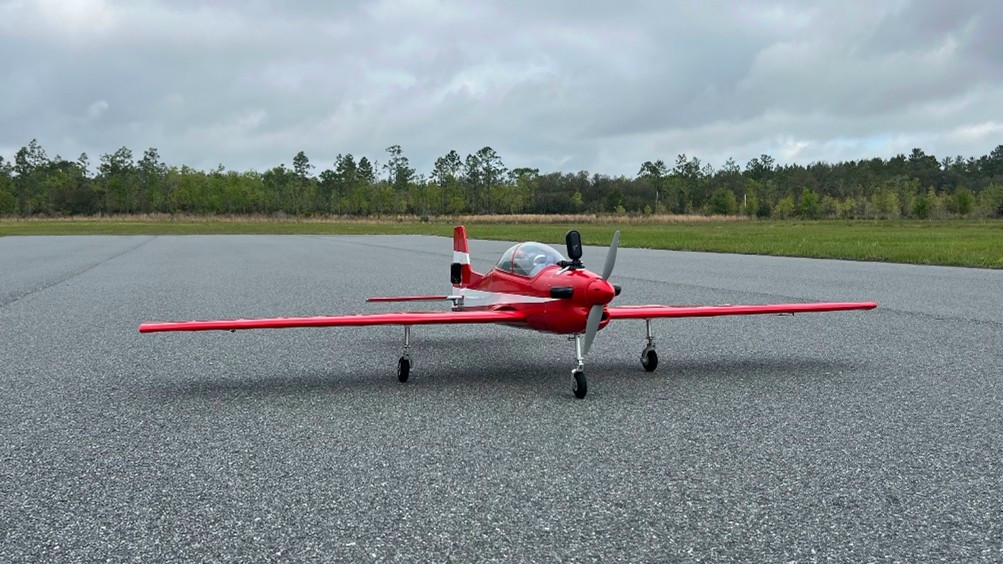
// Senior Aerospace Design capstone — autonomous RC aircraft
Project Overview
As part of the senior aerospace design capstone at the University of Florida, my team was tasked with designing, building, and testing an RC aircraft capable of executing a self-defined mission. We created a fictional company — Sweet Silence — whose product autonomously delivers pacifiers to restore quiet in urban environments.
The project was divided into four engineering roles: Aerodynamics, Avionics, Structures, and Controls. As the Controls Engineer, my responsibility was to design and validate a complete autopilot system using MATLAB and Simulink.
Technical Work
Control Architecture
I developed a full closed-loop controls architecture that covered both low-level actuator response modeling and high-level trajectory management. The mission profile demanded robust altitude hold, effective yaw damping, and the ability to accurately fly through multiple waypoints with minimal deviation.
The instructor provided baseline MATLAB code for the Altitude Hold and Yaw Damper control loops. My task was to adapt the control architecture to the specific state-space model of our aircraft — developed by the Aerodynamics specialist — and design the gains from scratch.
Gain Design & Validation
Using root locus techniques, I determined appropriate proportional and integral gains for each control loop. I validated the designs with Bode plots to confirm sufficient gain and phase margins. Extensive time-domain simulations confirmed the system met performance targets for overshoot, rise time, settling time, and steady-state error.
Actuator Modeling
To verify real-world feasibility, I modeled the actuator dynamics for the elevator and rudder, ensuring they could achieve the required deflections smoothly and without lag.
Waypoint Navigation
I integrated the waypoint navigation logic, enabling the aircraft to autonomously fly through three consecutive waypoints — a critical requirement for completing the autonomous payload delivery mission.
PID vs. LQR Comparison
I compared the classic PID controller with a Linear Quadratic Regulator (LQR) approach, demonstrating performance trade-offs between the two methodologies and optimizing the final design to best suit the mission profile.