nanobOx Engineering Intern
Nanobubble oxygenation technology startup — Dublin, Ireland
About nanobOx
nanobOx is a 2022 Enterprise Ireland 'Big Ideas' first prize winner. The company's mission is to increase the sustainability of bio-processes by using nanobubble technology to lower energy costs and reduce synthetic chemical use while increasing productivity. It operates as a small, tight-knit team of engineers pushing an innovative design toward market.
I joined nanobOx as an engineering intern for 10 weeks, working on two independent projects focused on optimizing the testing of nanobubble oxygenation systems.
Project 1 — O₂ Testing Optimization
The Problem
The existing testing pipeline required manual data collection, limiting throughput and introducing latency in performance analysis. I was tasked with automating data transmission and enabling remote access to test results.
The Solution
I implemented a system using a Remote Terminal Unit (RTU) — specifically the RT600 by WLINK — to wirelessly connect the dissolved oxygen sensor to a server. I coordinated directly with both WLINK and the DO sensor manufacturer to correctly pair the two devices and configure the data pipeline.
The integration enabled real-time data upload to a remote server, allowing results to be automatically charted and exported to Excel — eliminating manual transcription and enabling analysis from anywhere.
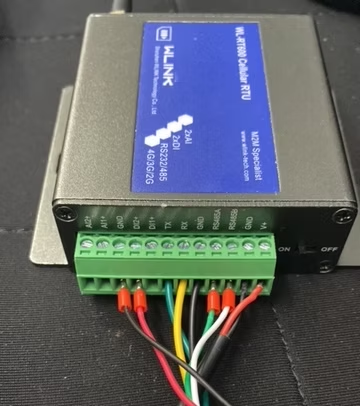
// RTU (RT600 by WLINK) testing setup at nanobOx, Dublin
Project 2 — Custom O₂ Measurement Instrument
Sensor Selection
I began with extensive research to identify sensor types that could meet the project requirements. After communicating with organizations across multiple countries, I selected the TO2-19 Hybrid Sensor Cell by Southland Sensing Ltd. as the optimal solution for measuring oxygen in a gaseous state.
Instrument Design
Since the sensor requires the water sample to be fully vaporized, the instrument needed an internal chamber capable of heating water to 100°C. After evaluating several heating methods, I settled on induction heating for its precision and compactness. I also learned and applied KF-40 vacuum fittings and piping standards to design the instrument's structural assembly.
Outcome
Due to part lead times, I was unable to complete assembly and testing before my internship ended. However, I maintained thorough documentation throughout — including sensor specs, design rationale, supplier contacts, and assembly drawings — enabling the nanobOx team to continue the project seamlessly after my departure.