Aeromorph — Physical Reservoir Computing
Design, manufacture, and characterization of a nonlinear metamaterial for use as a Physical Reservoir Computer
Note: This work is part of the ongoing Aeromorph project — a collaboration between the Air Force Research Lab (AFRL), Florida State University, and the University of Florida. The associated paper has not yet been published.
Background
Traditional Structural Health Monitoring (SHM) relies on costly, periodic inspections that leave gaps where damage can progress undetected. A Physical Reservoir Computer (PRC) offers a path forward: a physical system whose intrinsic nonlinear dynamics perform the computational work of a neural network, enabling real-time data-driven monitoring without the training overhead of conventional machine learning.
A Reservoir Computer maps input data into a high-dimensional space through nonlinear transformations, making otherwise difficult machine learning tasks tractable. The key advantage is that only the output layer requires training — the physics of the structure does the rest.
The goal: design and manufacture a metamaterial — an engineered structure defined by specific mechanical properties — that exhibits the nonlinear dynamics required to function as a PRC.
Project Phases
ReLU Beam Design & Static Testing
The Rectified Linear Unit (ReLU) activation function — a building block of neural networks — inspired the beam geometry. I designed a 3D-printed TPU beam whose cross-section transitions from a compliant region to a stiffer one, producing a bilinear (ReLU-like) force-displacement response. Two beam designs were modeled analytically using moment of inertia ratios and deflection theory, fabricated, and validated through static testing on a custom stand with a laser vibrometer. Both confirmed the target nonlinear deformation behavior.
2D Metamaterial Unit Cell Design
Building on the validated ReLU beam, I designed a 2D metamaterial unit cell — a grid of ReLU beams arranged to provide spatially distributed nonlinear dynamics. Multiple accelerometers at different nodes give the PRC its high-dimensional state space, which is what enables the system to perform computational tasks.
Dynamic Testing & PRC Characterization
I co-designed the dynamic test stand and protocols. The metamaterial was excited with frequency sweeps and single sine waves; accelerometers captured the full-field dynamic response. Performance was benchmarked using NARMA tasks (NARMA-2, -5, -10), with NARMA-5 achieving a best R² ≈ 0.6. The system successfully demonstrated nonlinear signal separation, but performance was limited by insufficient phase offset between structural regions — pointing to a need for added damping in future designs.
FEA Validation & Wind Tunnel Hardware
I validated SolidWorks Simulation FEA models against hand calculations and experimental results to establish a reliable dynamic baseline. As the project scaled to supersonic wind tunnel testing, I designed the test mount frame to fit within the tunnel's geometric constraints and a pressure equalization vent — calculating its cutoff frequency to confirm it would not interfere with test measurements.
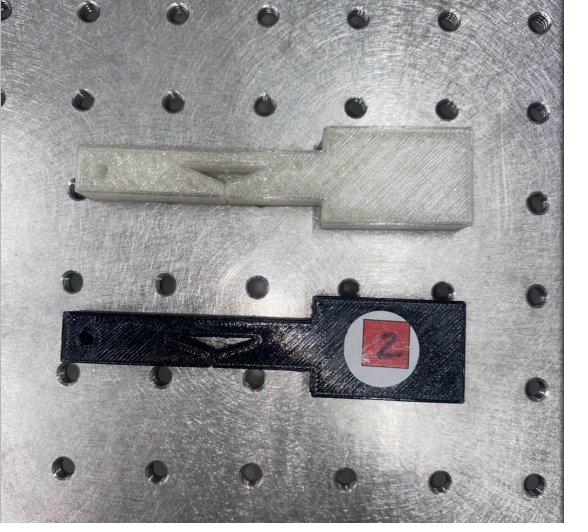
// ReLU beam designs on static test stand
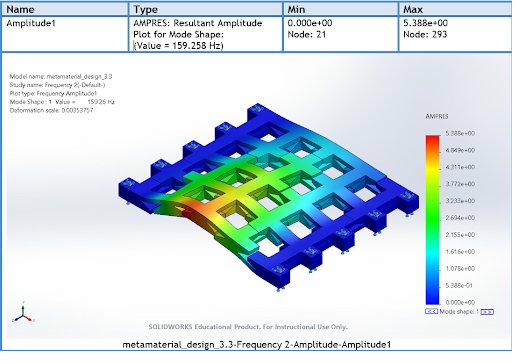
// 2D metamaterial unit cell
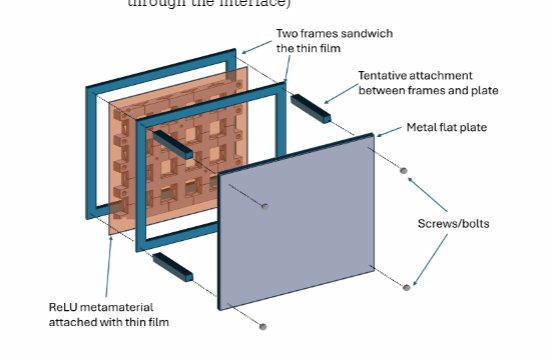
// Supersonic wind tunnel test mount assembly
Key Findings
The PRC achieved nonlinear signal separation and contained the frequency content required for reservoir computing. The primary limitation was a lack of fading memory — traced to insufficient phase offset between structural regions, meaning different parts of the metamaterial responded too similarly, reducing computational capacity.
Future iterations will introduce damping (e.g. added weights) to create temporal lag between regions, and refine sensor placement to better capture useful dynamic modes.